
Previously, we learned why people share. The meta-analysis of fifty nine studies showed that electronics, textiles, and household items dominate sharing behavior, and that outcome efficacy matters more than convenience alone. People share more when they see tangible results and feel part of something bigger.
But here is the puzzle. Neighbor-to-neighbor sharing clearly works. People sign up. Items move. Local networks form. Yet a huge portion of users quietly drop off after their initial enthusiasm. The issue is not that the current platforms are doing everything wrong. The issue is that the ecosystem is still missing several core pieces people consistently say they need in order to stay engaged.
What’s Actually Working
Before identifying what is missing, it is worth acknowledging where real progress has already been made.
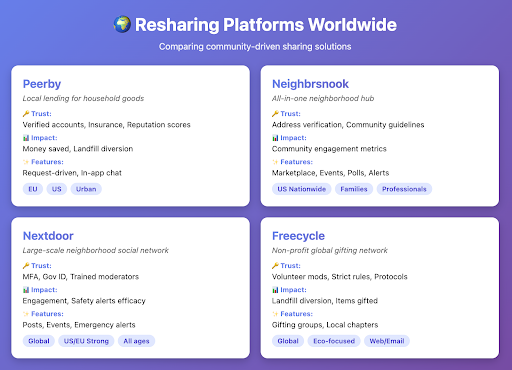
Trust and verification have improved dramatically. Modern sharing systems increasingly rely on identity checks, profile verification, reputation scores, and community moderation. These tools reduce the baseline uncertainty that historically prevented neighbors from sharing with each other.
Convenience is getting better. Request-driven models reduce the need to scroll through long lists of items. Smarter recommendations help people find what they need without digging. More platforms are recognizing that if borrowing is more work than buying, people will not bother. Simplicity is no longer optional.
Impact is far more visible than it used to be. Some communities show users how much money they saved or how many items were diverted from landfills. Others track local contributions or celebrate milestones. This matters because it lines up exactly with the research. People stay involved when they can see the outcomes of their participation.
These are meaningful steps forward. But they highlight the remaining gaps even more clearly, because what is missing is not basic functionality. What is missing is deeper infrastructure that supports the way people actually behave.
The Gaps That Matter Most
Across the many platforms and communities examined, three gaps consistently limit adoption and long-term participation.
1.) Participation Still Depends Too Much on Active Effort
Most sharing systems assume users will list items, monitor requests, and respond quickly. But the majority of people are occasional participants, not power users. They want to help and they want to borrow, but they do not want to manage listings or constantly check notifications. The ecosystem needs design that supports these users without demanding ongoing effort.
Optional home inventories, one-tap approvals, and automation that quietly matches what people own with what others need can transform engagement. Instead of expecting people to post, the system should handle the heavy lifting and invite participation at just the right moment.
2.) Trust, Safety, and Liability Still Feel Unclear
Many platforms reference trust and safety, but ordinary users rarely know what happens if something is damaged, lost, or misused. Insurance exists in fragments across the landscape, but it is inconsistent, complicated, or hidden in legal text. This uncertainty is enough to stop a huge number of people from sharing valuable items.
The ecosystem needs simple, standardized coverage that is automatic and easy to understand. People should know, in plain language, what is protected and how disputes are resolved. When the rules of risk are blurry, participation stays low.
3.) Sharing Is Treated as a Transaction, Not a Relationship
The research is very clear that people share to feel connected, not just to access items. Yet most sharing flows today are built like delivery or marketplace flows. Request, match, pick up, return, done. Efficient, but not relational.
Communities that integrate gratitude, skill sharing, neighborhood events, and recurring micro interactions tend to build stronger participation. When people feel recognized and connected, the item exchange becomes the start of a relationship rather than a one-off interaction. Without that social layer, participation stays transactional and fades quickly.
Building Platforms That Work for Communities
The next generation of sharing platforms will not succeed by adding features one at a time. The strongest products will address these gaps together and reinforce one another.
That starts with reducing friction for the everyday user through automation and intelligent matching. Participation should feel effortless for people who want to contribute but do not want to manage listings. Trust and safety should be built into the foundation, with clear and automatic coverage that makes participation feel low risk. And the social layer needs to be intentional. The experience should help people feel seen, appreciated, and connected, because those are the conditions that keep communities active.
Moderation, accessibility, and density also matter. The best systems will blend automated safeguards with community context and trained oversight. They will support multiple channels so people with different levels of digital literacy can participate comfortably. And they will adapt to different environments so sharing feels active whether you live on a dense urban block or a quiet rural road.
The research from those fifty nine studies tells us what people want to share and why they want to share it. The task now is to design systems that remove the friction sitting between intention and action. When sharing becomes simple, safe, and socially meaningful, people do not just try it once. They return, contribute, and strengthen the communities around them.
References:
Bradley, K., & Pargman, D. (2017). The sharing economy as the commons of the 21st century. Cambridge Journal of Regions, Economy and Society, 10(2), 231-247.
Hellwig, K., Morhart, F., Girardin, F., & Hauser, M. (2015). Exploring different types of sharing: A proposed segmentation of the market for “sharing” businesses. Psychology & Marketing, 32(9), 891-906.
Mont, O., Palgan, Y. V., Bradley, K., & Zvolska, L. (2020). A decade of the sharing economy: Concepts, users, business and governance perspectives. Journal of Cleaner Production, 269, 122215.
Vith, S., Oberg, A., Höllerer, M. A., & Meyer, R. E. (2019). Envisioning the ‘sharing city’: Governance strategies for the sharing economy. Journal of Business Ethics, 159(4), 1023-1046.