
What 59 Studies Reveal About What People Actually Want to Share
Forget the conventional wisdom about sharing platforms. A massive meta-analysis of 59 studies across 366 samples just revealed what people actually want to share. The results might surprise you.
Understanding the Distinction: Sharing vs. Reuse vs. Donation
Before diving into the data, it’s crucial to understand what we mean by sharing. The research literature distinguishes between several related but different concepts:
- True Sharing – Temporary access to underutilized goods owned by individuals, with or without compensation. The original owner retains ownership and expects the item back.
- Collaborative Consumption/Renting – Structured platforms where people pay for temporary access without ownership transfer.
- Reuse/Donation – Permanent transfer of ownership where items get a second life with new owners.
What the Research Really Shows: Reuse & Sharing Categories
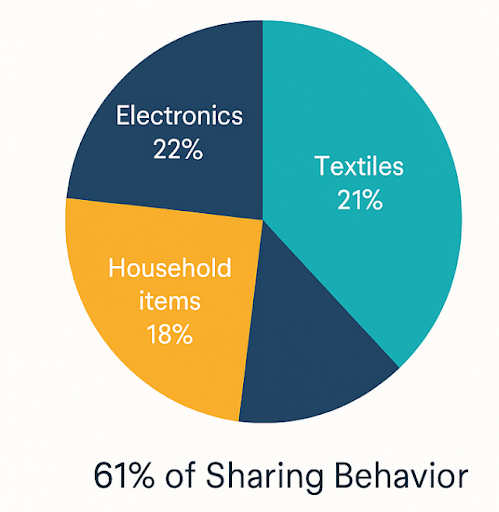
When researchers crunched the numbers, three categories consistently led sharing activity:
- Electronics (22%) – Phones, tablets, gaming devices, and cameras. Interestingly, people often prefer to donate electronics once they’re done with them, rather than share while still using them. Privacy and security concerns play a big role here. For true sharing platforms, the sweet spot is lending out specialized equipment (like cameras or gaming consoles) that people need only occasionally.
- Textiles (21%) – Clothing, linens, and seasonal wear. From costume swaps to borrowing special-occasion outfits, textiles lend themselves naturally to short-term access without the need for permanent transfer.
- Household Items (18%) – Kitchen gadgets, tools, furniture, and appliances. These are ideal for neighborhood sharing because they sit unused most of the time but are needed for specific tasks.
Together, these three categories make up 61% of all sharing behavior. The lesson? Successful sharing platforms need broad category coverage, not narrow, niche focus.
Why This Matters for Community Platforms
Many sharing startups pick a single category — tool libraries, clothing swaps, electronics exchanges. But the research suggests this misses the bigger opportunity.
People don’t think in categories when they’re decluttering. They think: “What do I have that someone else might need?” Platforms that reflect this mindset — with broad category coverage — are more likely to stick.
The Outcome Efficacy Factor
Here’s the crucial finding: people share more when they see tangible results.
Studies showed that outcome efficacy — proof that sharing makes a difference — drives long-term participation. Examples:
- “Your neighbors saved $2,847 this month through sharing.”
- “This community prevented 156 lbs of waste from landfills.”
- “12 people discovered new hobbies through borrowed items.”
These metrics transform sharing from a transaction into a movement.
What Doesn’t Drive Sharing
The meta-analysis also revealed what doesn’t predict sharing behavior:
- Age and income – Contrary to stereotypes, sharing isn’t just for the young or budget-conscious.
- Pure convenience – A slick app helps, but convenience alone doesn’t build communities.
- Financial incentives – Money motivates ride-hailing or rentals, but community sharing runs on different psychology.
The Real Drivers
Three factors consistently predicted sharing success across all 59 studies:
- Attitudes toward sharing – People who see sharing as positive and socially valuable are more likely to join in.
- Knowledge and awareness – Understanding the environmental and community benefits boosts participation.
- Social norms and peer influence – What people see others doing matters more than what they think privately.
The Bottom Line
The sharing economy isn’t about any single category of stuff. It’s about shifting how communities think about ownership and waste.
Platforms that understand this won’t just facilitate transactions — they’ll transform neighborhood resource flows.
The data is clear: when sharing is easy, visible, and impactful across categories, communities respond. The real question isn’t what people want to share — it’s whether we’re ready to build platforms worthy of their generosity.
References:
Bradley, K., & Pargman, D. (2017). The sharing economy as the commons of the 21st century. Cambridge Journal of Regions, Economy and Society, 10(2), 231-247.
Gu, Y., Xia, Z., Tian, X., Xie, J., & Liu, Y. (2024). Factors determining reuse behavior: A meta-analysis. Cleaner and Responsible Consumption, 14, 100213.
Hellwig, K., Morhart, F., Girardin, F., & Hauser, M. (2015). Exploring different types of sharing: A proposed segmentation of the market for “sharing” businesses. Psychology & Marketing, 32(9), 891-906.
Ho, M.-X., & Yanagisawa, H. (2023). Design for Well-Being and Sustainability: A Conceptual Framework of the Peer-to-Peer Sharing and Reuse Platform in the Circular Economy. Sustainability, 15(11), 8852.
Stockholm Environment Institute. (2019). Transformational change through a circular economy. Stockholm Environment Institute.