
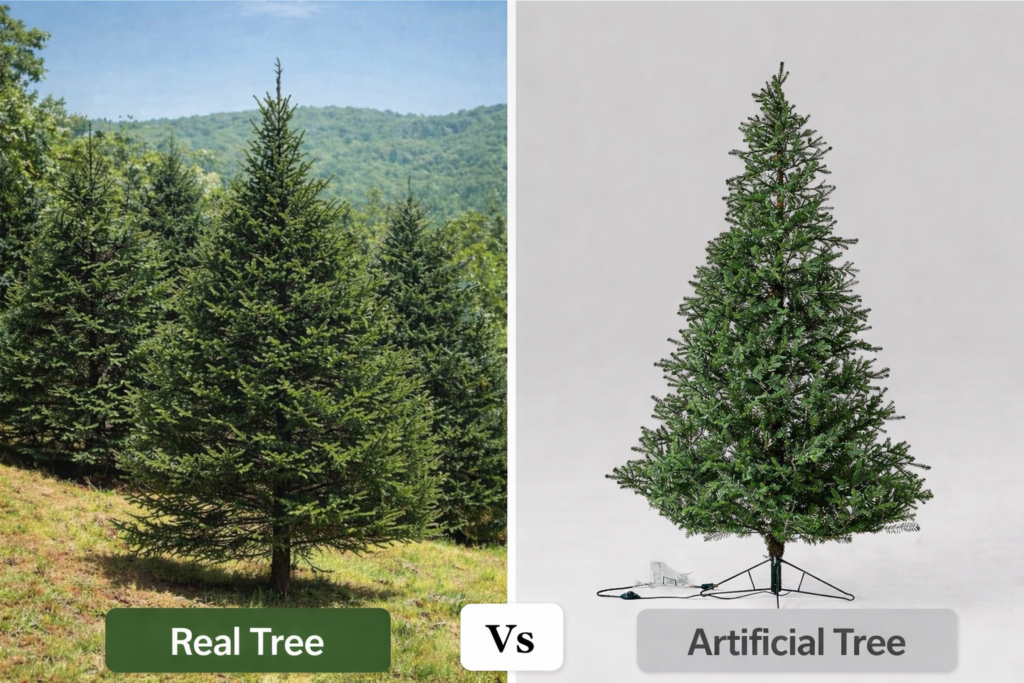
Every December, we make dozens of tiny holiday decisions that add up. What to gift, how to wrap, what to cook, how to decorate. One of the biggest and most visible choices is the Christmas tree we pick.
People often frame it as a simple choice between a real tree or fake tree. But the more impactful question is this: how do we get the joy of a tree while wasting as little as possible?
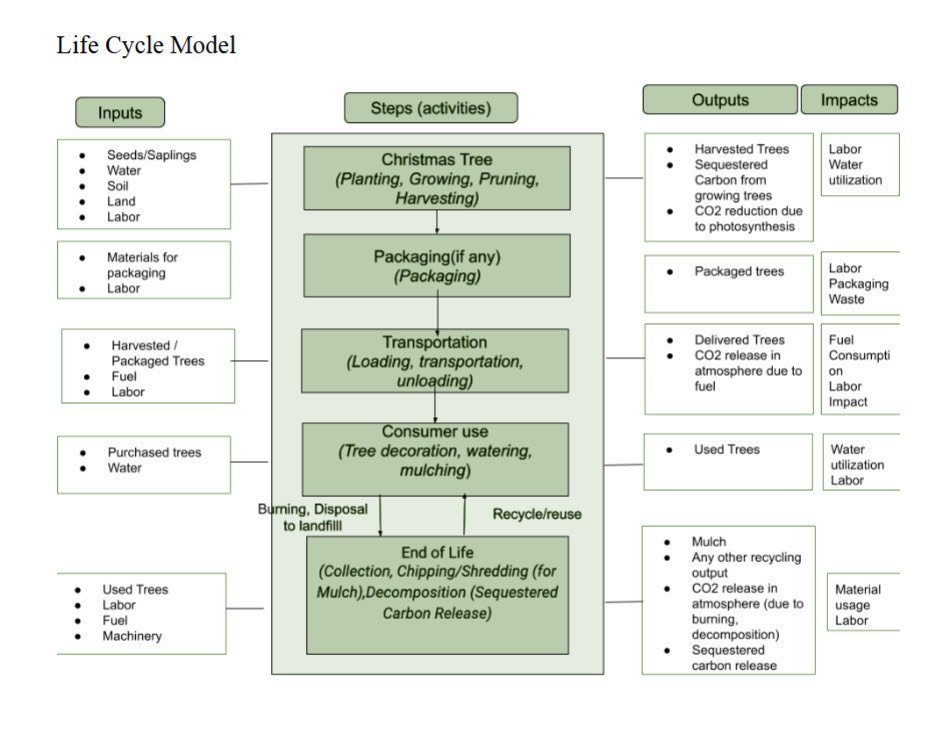
A simple life cycle view helps. A tree is not just what sits in your living room. There are inputs (seedlings, water, land, labor), activities (growing, harvesting, packaging, transportation, use), and an end of life (mulch, compost, burning, landfill). Each stage has different impacts, and the levers that matter most are usually transportation and disposal.
The greenest tree is the one you already have
If you already own an artificial tree, keep using it. If you have access to a used artificial tree through family, neighbors, or a buy nothing group, that is often an even better move than buying anything new. The most circular tree is the one that stays in use and out of the waste stream.
The same logic applies to real trees too. If your building, campus, or community does a shared tree in a lobby or common space, participating in that shared option can reduce the number of trees purchased overall.
What a real Christmas tree gets right
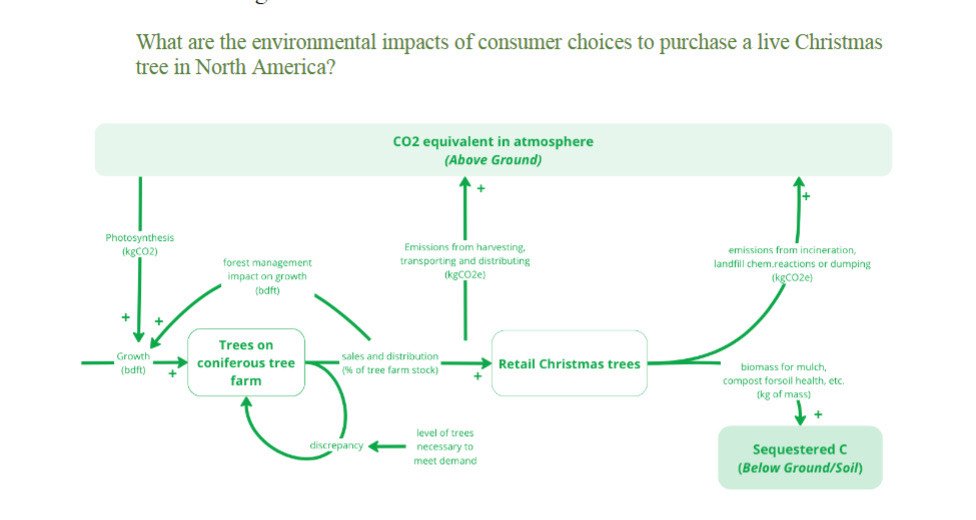
Real trees are renewable and are typically grown on tree farms, not cut from old growth forests. While they are growing, they store carbon through photosynthesis. The catch is that some of that climate benefit can be offset by how the tree is grown, how far it travels, and what happens after the holidays.
If you choose a real tree, these are the biggest ways to lower the footprint:
1) Buy local, and minimize the driving.
Transportation emissions can be a major part of the footprint, especially if you make a long car trip just for the tree. Combine the tree run with other errands, carpool, or choose a closer seller.
2) Look for better growing practices.
Slow grown trees and less intensive production can be preferable. If available, check for Forest Stewardship Council certification.
3) Treat end of life like it matters, because it does.
Mulching, chipping, and composting keep the tree useful and can cut emissions significantly compared to landfill. Landfill disposal can generate methane as the tree decomposes, which increases climate impact.
This is where local programs are a circular win. Many municipalities offer free tree pickup and mulching. If your town has that service, use it and encourage others to do the same.
What an artificial tree gets right, and what it gets wrong
Artificial trees usually have higher upfront impacts because they are manufactured from plastics and metals, then shipped long distances. Multiple life cycle assessments find that artificial trees generally need many years of reuse to compete with buying a new real tree each year.
There is also a less visible issue which is the microplastic lifecycle. Many artificial trees use plastic and coatings that can slowly shed tiny fragments as they age, especially with repeated assembly, storage friction, heat from lights, and general wear. Those particles do not biodegrade. They can end up in household dust, get washed into waterways over time, and persist in the environment for decades.
So the artificial tree question is not “is it good or bad.” It is “will it stay in use long enough, and will it avoid becoming hard to manage waste later.” If it gets thrown out after a few seasons, you end up with both a high manufacturing footprint and long lasting plastic pollution. If it is used for many years, stored carefully, and passed on when no longer needed, you spread the impact over a longer life and reduce the chance it becomes a short lived plastic product.
If you go the artificial route, the circular playbook looks like this:
1) Buy secondhand first.
A used artificial tree avoids the manufacturing impact of a new one and keeps a bulky item out of the waste stream.
2) Commit to long term reuse.
If you buy a new artificial tree, plan to keep it for many years. The longer it stays in service, the more its initial footprint gets spread out over time.
3) Repair before replacing.
Store it carefully, replace missing parts, and avoid designs that fail easily. If it is pre lit and the lights fail, it often gets discarded earlier, so durability matters.
4) Pass it on when you are done.
If you outgrow your tree, donate or resell it instead of tossing it. Some initiatives exist specifically to keep artificial trees circulating in communities.
What is the Best Option?
If you have the right space, a potted tree with roots can be reused year after year, which spreads impact over multiple seasons and can avoid repeated transportation if it stays on the same property. Think of it as the holiday equivalent of a reusable bottle.
This is not practical for everyone, but it is a great fit for households with outdoor space, community gardens, or buildings that can store a living tree between seasons.
A quick decision guide for this season
If you want the simplest way to choose without overthinking it:
Already own an artificial tree: keep using it, and make it last.
Do not own a tree and have storage space: look for a secondhand artificial tree, or buy one you will keep for many years.
Do not own a tree and want a real tree experience: buy local and make a plan to mulch, chip, or compost it after the holidays.
Have outdoor space and want the most circular real option: consider a potted living tree you can reuse.
Live in a dorm or small apartment: ask your building or friend group about doing a shared tree, or coordinate a borrow and return system.
A Circular Impact Network challenge: Maximizing the Useful Life of Trees
Holiday decor is a perfect use case for circular systems because demand is seasonal and storage is the real barrier.
Here are a few community ideas that fit Circular Impact Network energy:
Start a “Tree Swap” in your building in early December, for artificial trees and stands.
Create a shared holiday storage corner for a floor or friend group so one tree serves many people over time.
Promote municipal mulching programs as a default end of life option for real trees.
Normalize secondhand holiday decor the same way thrifting is normalized for outfits.
Sources:
https://www.dovetailinc.org/upload/tmp/1579550365.pdf
https://earth.org/real-vs-fake-christmas-tree-environmental-impact/
https://cdn2.hubspot.net/hubfs/2591272/acta_christmas_tree_lca_final_report_by_pe_international.pdf
https://www.nationalgeographic.com/environment/article/history-origin-artificial-Christmas-trees
https://riverlink.org/pine-vs-plastic-the-ultimate-tree-showdown/